

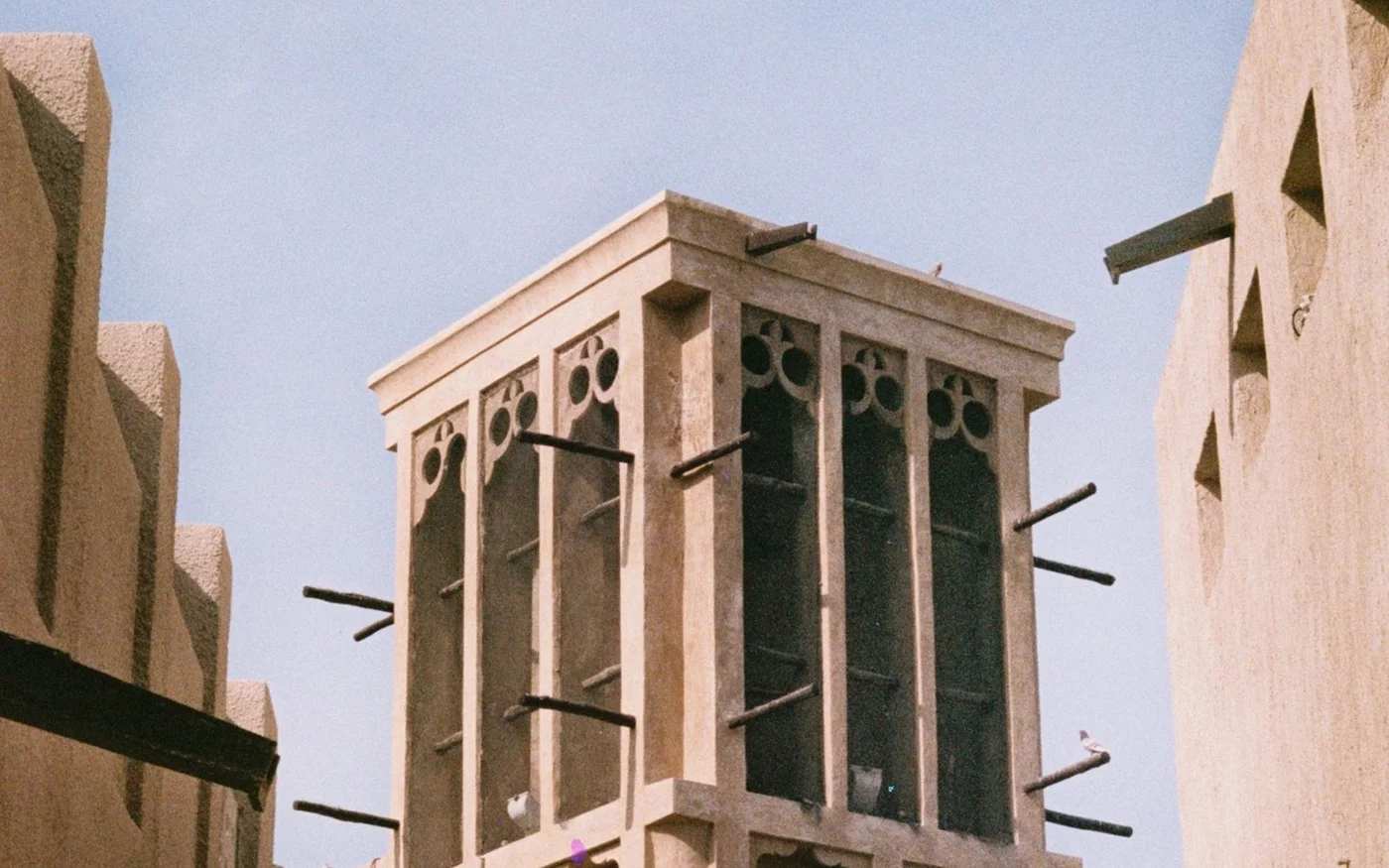
At XVA Art Hotel in Al Fahidi, a former family home has become a place to sleep, see contemporary art and sit in a courtyard. At Arabian Boutique Hotel in Al Shindagha, the hotel traces its rooms to two former residences, and one of its suites is described with a living area beneath a wind tower. Farther along the Creek, Al Seef Heritage Hotel offers rooms in a development whose designers set out to recreate the appearance of a much older waterfront settlement.
All three use architectural details associated with Old Dubai, but those details have different origins. The story of an adapted house starts with who lived there and how its spaces were used. The story of Al Seef starts with a development brief and decisions about how to build something new that fits beside a historic district. You can book a stay at each property. Which one suits you depends on whether you want to spend time in a former home, or want a larger hotel that uses the forms and materials of older Creek buildings.
Three approaches on the same side of Dubai Creek
| Hotel | Building provenance | What you can check before booking |
|---|---|---|
| XVA Art Hotel · Al Fahidi | Former Seddiqi family home adapted for hospitality and art | Individual room size, courtyard arrangement and access to café or gallery |
| Arabian Boutique Hotel · Al Shindagha | Two former residences identified by the operator | Which house and category you will stay in, terrace and arrival route |
| Al Seef Heritage Hotel · Al Seef | Modern heritage-style waterfront development beside historic districts | Room outlook, connecting rooms and transport to off-site leisure facilities |
Dubai’s National Cultural Map describes Al Fahidi as a place to see the kind of urban life that prevailed from the mid-nineteenth century into the twentieth. Visit Dubai describes preserved infrastructure and restored buildings in the historic neighbourhood. This gives the area a documented history, but it is not a construction date for each building. A hotel’s address tells you which district it belongs to. The history of the building still needs its own source. The opposite mistake is also easy to make. A new building may use a wind tower, an older building colour or a narrow lane to make the setting legible without claiming that the building has stood there for a century. National Cultural Map’s historical context · Visit Dubai’s Al Fahidi record
XVA adapted a family home around art and courtyards
XVA identifies its property as the former home of the Seddiqi family in Al Fahidi and traces its own inauguration to 2003. That date belongs to XVA’s operation rather than to the house. The operator’s pages also describe wind towers, shaded courtyards and rooms arranged around them. This is where the old building’s layout becomes tangible. The shared space is close to the rooms, and the atmosphere of the café and courtyard is part of how the hotel works. It is a small operation with several overlapping uses, from accommodation to an art display and a place for visitors to sit. XVA’s first-party building history · XVA’s courtyard and room descriptions
The current operator room page lists 15 rooms and gives dimensions rather than treating them as interchangeable. Single rooms are described at 12 to 13 square metres with a single bed. Standard rooms are listed at 13 to 15 square metres with a queen. The Deluxe category is listed at 15 to 17 square metres with a queen and private outdoor seating. Those differences matter if the room is where you expect to spend a long afternoon. The extra space in the Deluxe category is modest indoors, while the seating gives you another place to spend time. The hotel says each room contains work from XVA artists, so ask about the individual room if a particular layout or artwork draws you to it. Current room sizes, beds and art
On the hotel’s own pages, the courtyard is shared across parts of the business. The café invites visitors and describes service in shaded courtyards. The hotel’s homepage also describes events and a gallery. If your main interest is seeing how a traditional house accommodates a contemporary public use, a café or gallery visit is a direct route to part of that experience. If you want to sleep there, ask which room you are being offered and what its relationship to the courtyard is. The operator markets both privacy and common space, and an individual room can sit closer to one or the other. XVA’s courtyard café · XVA’s gallery and events information
There is also a small but useful warning in the operator’s own descriptions. Its room page refers to three courtyards, while the homepage title refers to two. Visit Dubai’s older guide gives 14 rooms rather than the 15 in the operator’s room listing. That is why the useful facts are that XVA is a small courtyard property and that its current room page lists 15 rooms. The differences in count do not establish exactly what changed or when. If the placement of your room matters, direct confirmation from XVA is more useful than trying to reconstruct the current floor plan from the promotional summaries. Current XVA room listing · Visit Dubai’s older room-count reference
The art use is particularly helpful for understanding this conversion. XVA says it places selected works around the hotel and café as well as displaying art through its gallery. A visitor therefore encounters the work in spaces that still have other jobs. The café remains a place to sit, and the accommodation remains a place to sleep. If a particular exhibition is the reason for going, check its dates with the gallery. If you are choosing a room, ask about the practical features first. In a house where the operator deliberately varies the interiors, an exhibition image or room photograph is a starting point for an enquiry about the space you will actually use. XVA’s hotel and gallery account
Arabian Boutique Hotel puts two Al Shindagha houses back into everyday use
The operator identifies one of the houses with Thani bin Abdullah Al-Rumaiti and the other with Al Dewais, whom it describes as a wood merchant. Contemporary coverage identifies the former Al-Rumaiti residence as the restored house in which the hotel began welcoming guests in early 2024. The hotel’s current site describes 20 rooms and suites across two houses. An early review described a smaller room offering, so the useful current figure is the operator’s two-house total. It does not establish the date every room entered inventory, and the published material does not provide a detailed conservation record for every wall or fitting. Arabian Boutique Hotel’s house histories · Current operator room total · Contemporary opening and restoration reporting
The operator’s room list makes the relationship between the houses and the stay more specific. It describes the Junior Suite with a living area beneath a traditional wind tower. Other listings refer to a Khor Suite and heritage room categories. The wind tower is an architectural element within one described category, so a visitor who wants that experience should ask for the exact room and house. The operator also describes a Creek View Terrace. A suite view, a view from a shared terrace and a feature inside a room are separate parts of the stay. The category confirmation is the best way to know which you are getting. Hotel room and suite descriptions · Hotel facilities and Creek View Terrace
Co-owner Ali Alrais described the project in a 2024 interview in terms of sharing a way of living with visitors, following the family’s work in Emirati hospitality. The point of that account is the continuity of use. A visitor can spend time in an adapted residential setting rather than simply view it as an exhibit. The hotel’s current site lists accommodation, a courtyard and terrace facilities. Those are the practical ways the project gives the houses a new role. The separate museum and its restored buildings belong to the wider district, with their own visitor arrangements. A hotel room does not imply access to those houses. Published interview with co-owner Ali Alrais · Current hotel facilities
For a guest, the two-house arrangement is a reason to check the route as well as the room. Ask where the vehicle should drop you, how luggage reaches the room and whether there are stairs between the accommodation and the spaces you intend to use. If you want a quiet corner in the morning, find out whether your seating area is private or shared. The design appeal comes from retaining the scale of a house. Knowing how the rooms are laid out helps you judge whether that scale works for your stay. Operator address and room enquiry route
It also helps to use the hotel’s exact location when planning arrival. Its contact page gives Creek Street, Exit 3 and publishes map coordinates. The operator lists check-in from 2pm and checkout at 11am. That gives a short stay a different shape from a hotel with a later checkout, particularly if you plan to spend the morning on the terrace. Ask where luggage can be left if you want to stay in the neighbourhood after checking out. The historic setting may be what draws you there, but the practical experience starts with the entrance and the route through the property. Arabian Boutique Hotel’s directions and published check-in times
Al Seef built a new hotel in a traditional waterfront setting
Dubai’s Protocol Department reported the completion of Al Seef’s first phase in December 2017 and described a new cultural and tourism project spanning 1.8 kilometres along the Creek. The design account from Godwin Austen Johnson describes the challenge of making newly designed buildings look as if they had aged in place. The project drew on traditional building forms and deliberately used ageing techniques. The weathered effect is therefore part of the design, alongside the wind towers and the narrow streets. It cannot serve as evidence that the guest buildings were once occupied by historic merchant families. The historic neighbourhoods nearby have their own conservation histories. Dubai Protocol’s first-phase record · GAJ’s heritage design account
The landscape designer’s project account explains a related decision. The wider public realm includes a contemporary area and a heritage area, with the latter using forms such as barjeel wind towers and palm-leaf structures as references. That gives the visitor a sequence of streets and spaces in which older architectural ideas are legible at walking scale. It is a contemporary interpretation of the Creek waterfront. The heritage is in the design references and the relationship to the setting. The age of the hotel buildings is a separate fact. Cracknell’s project submission on the heritage waterfront
Hilton’s current listing gives 190 rooms, an outdoor majlis, a playground and connecting rooms. It also directs guests to the pool, spa and fitness centre at Canopy by Hilton Dubai Al Seef, with transport between the properties. That is an important operating detail if the hotel’s look makes you expect a self-contained resort. A room in the heritage hotel and the off-site pool can be part of the same stay while requiring separate movement. Check the transport hours and the service you intend to use. For a family, also confirm connecting rooms for the actual booking, and compare the meal terms for children. Hilton says room packages that include meals exclude children’s meal charges. Hilton’s current hotel and off-site leisure information
Hilton’s room and gallery material shows how the setting changes with the room category. A Heritage Room with Souq View faces the spaces used by visitors moving through the development. The waterfront setting is part of the hotel’s identity, but a room sold for a souq outlook is a different choice from one selected for the Creek. Confirm the view and any balcony in the room description before paying. The project’s design can still be experienced in the lanes and outdoor majlis even if your room faces inward. It is worth deciding whether the view is for time in the room or something you would rather see on foot. Hilton’s heritage room and property gallery
How to choose a stay when the building is the reason for going
Start by deciding where you want to spend time. At XVA, room size and the courtyard matter more than the number of facilities. At Arabian Boutique Hotel, the exact house and category matter if you are interested in the wind tower or a particular outlook. At Al Seef, it makes sense to look at the hotel as one part of the waterfront development, with some facilities operating at a separate address. Those distinctions are useful before you get to a rate comparison. A flexible rate in a room you will use can offer more practical value than a larger room or broader hotel package that does not fit your plans.
Before paying, check the property’s current arrival instructions, the exact room type and the services you care about. When comparing two small hotels, ask about stairs and shared spaces before assuming that the term boutique implies a particular layout. When comparing the heritage-style development with a former home, use the project and property histories alongside the room pages. You can appreciate both the care involved in reusing a house and the design choices behind a new waterfront. Knowing which you are booking makes it easier to see what each place contributes to the Creek today.
The distinction can also help when you see an individual architectural detail in a booking photograph. A wind tower above a room tells you what the structure looks like today. At the former houses, ask how that feature relates to the specific accommodation and what can be seen from inside. At Al Seef, the project history explains why the same form appears across newly designed streets. Likewise, a courtyard may give an overnight guest a place to sit or serve as part of a café or event setting. Check which uses will overlap during your visit if that space is important to the stay.
Comments (0)
No comments yet. Be the first!