

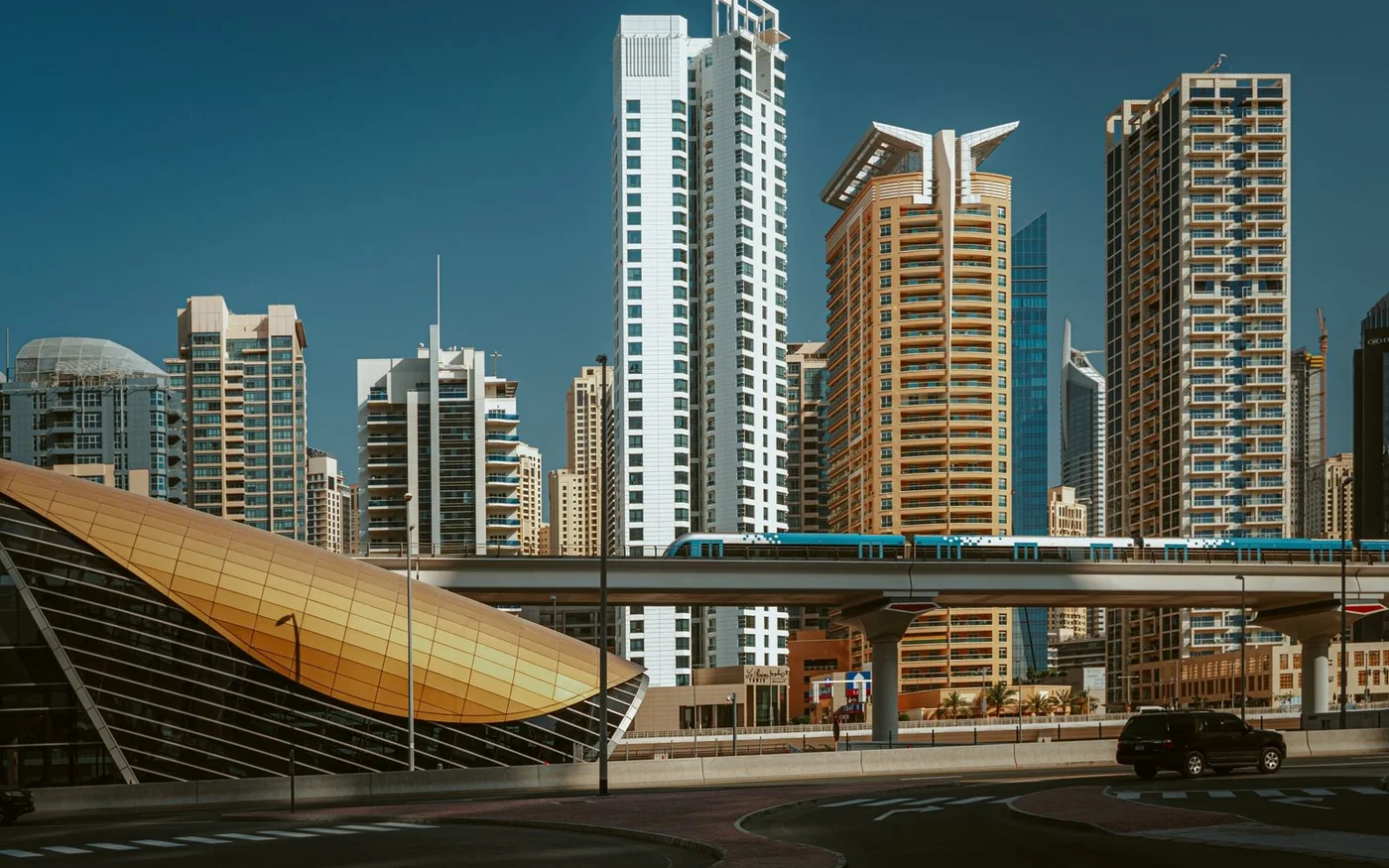
The Dubai Metro Blue Line will bring a new rail connection to communities stretching from the Creek to Academic City, with another branch through Mirdif and Al Warqa. Its importance is the way those places will connect: the planned line meets the Green Line at Creek, the Red Line at Centrepoint and brings its two routes together at International City 1.
The opening target is 9 September 2029. For a resident following construction or considering a future commute, that means there are two separate questions to answer: what the new network is designed to do, and how to make the journey with the services running now.
Official project and passenger-information pages checked on 5 November 2026. The Blue Line is a development project, not a passenger service available to board today.
The key project facts
| Question | Confirmed project information |
|---|---|
| How long is the line? | 30 kilometres, with 14 stations. |
| Where does it meet existing lines? | Creek on the Green Line and Centrepoint on the Red Line. |
| Where do its two routes connect? | International City 1. |
| When is it scheduled to open? | 9 September 2029, according to RTA's published project programme. |
| Can I plan a Blue Line trip now? | No. Use operating services for current journeys and treat the Blue Line as a future connection. |
RTA's 17 December 2025 project forum update gives the scheduled opening date. Its Metro project overview describes the route and principal interchanges. The practical value of those interchanges is worth understanding before looking at any individual district.
Two routes, joined at International City
The route has two approaches from the existing Metro network. One begins at Creek in Al Jaddaf and continues towards Academic City. The other begins at Centrepoint in Al Rashidiya and reaches International City 1 through Mirdif and Al Warqa.
RTA's December 2024 contract announcement sets out a 21-kilometre route with 10 stations from Creek towards Academic City, and a nine-kilometre route with four stations from Centrepoint to International City 1. The project includes a depot in Al Ruwayyah 3.
| Route | Areas described in RTA's route sequence |
|---|---|
| Creek to Academic City | Creek / Al Jaddaf, Dubai Festival City, Dubai Creek Harbour, Ras Al Khor, International City 1, International City 2 and 3, Dubai Silicon Oasis, Academic City. |
| Centrepoint to International City 1 | Centrepoint / Al Rashidiya, Mirdif, Al Warqa, International City 1. |
This is an area sequence, rather than a complete station-by-station passenger map. It explains the shape of the project without assigning an entrance to a particular building or treating every district label as a final station name.
Why the three interchanges matter
Creek connects the Blue and Green lines
Creek is the existing Green Line station in the Al Jaddaf area. It should be distinguished from the planned Blue Line station at Dubai Creek Harbour: the similar names refer to different places in the project description.
That distinction matters when arranging a meeting or examining a route. A person travelling to a waterfront address needs the correct destination, not simply the word “Creek” in a station search. Keep the specific district and the address together when comparing current and future journeys.
Centrepoint connects the Blue and Red lines
Centrepoint is the Red Line interchange identified in the Blue Line plans. Its role gives the Mirdif and Al Warqa branch a connection to the established Red Line network.
For a future passenger, the useful question is where the journey continues after that connection. The attraction of an additional rail option depends on the full trip, including any transfer and the distance from the destination station to the final address.
International City 1 brings the two routes together
International City 1 is the interchange within the Blue Line scheme. The station's role is different from Creek or Centrepoint: it connects the project's two route approaches. In its June 2025 foundation-stone announcement, RTA again identified the line's connections and its role in serving residential and academic areas.
For anyone living or working in the wider International City area, exact access will matter. A large district can contain very different starting points. The future station location, its entrances and the route from a particular building should be assessed together as detailed passenger information becomes available.
Which journeys could become more connected?
The planned service areas bring together several kinds of trip: journeys from established residential districts, travel to education and employment areas, and connections to waterfront communities. That mix is more useful to understand than a single claim about how the line will change the whole city.
If your regular destination is Academic City or Dubai Silicon Oasis, examine the connection between that exact address and the planned rail corridor. If you live in Mirdif or Al Warqa, consider how the Centrepoint connection might fit the places you already visit. If Dubai Creek Harbour is part of your routine, distinguish its future station from today's Green Line station at Creek.
These are ways to assess a future option, rather than a confirmed operating itinerary. Train stopping patterns, platform information and final passenger arrangements will determine how a particular trip works when the service launches.
A household can make this practical by writing down three repeated journeys and tracing each from door to door. Compare the present route with the future connection separately. That keeps a promising long-term improvement visible without giving it the same weight as a journey you can make this week.
What is distinctive about the engineering?
The contract announcement describes a line combining underground and elevated sections, including a 1.3-kilometre crossing over Dubai Creek. The contract was awarded to the MAPA, LIMAK and CRRC consortium at a stated value of AED20.5 billion. These are infrastructure project figures, not passenger charges.
At Dubai Creek Harbour, the June 2025 announcement presented the design of Emaar Properties Station, by Skidmore, Owings & Merrill. RTA described a gateway-inspired structure standing 74 metres high. That figure concerns the planned station structure; it should not be read as the height of every platform or station on the line.
Below ground, tunnelling is one part of a much larger construction process. RTA's May 2026 newsletter reported the launch of primary tunnelling works. Its official reel introducing the Al Wugeisha tunnel-boring machine illustrates the technical side of that stage.
The reel is useful construction context. A completed tunnel section, however, is one milestone within a railway project that also needs stations, track, systems and the steps required before passenger operations.
Read progress announcements with their dates attached
On 9 November 2025, Emirates News Agency reported RTA's announcement that construction had reached 10% completion. The December 2025 forum update recorded a later 12% milestone. Both are dated progress reports, rather than a current construction percentage for November 2026. Read the November 2025 milestone report.
The December forum release also described concrete-production and storage facilities in Al Ruwayyah 3 and International City. Such updates show how delivery is being organised as well as what has been built. They answer a different question from a passenger opening announcement.
When following the project, look for the date, the part of the works involved and the milestone being reported. A percentage is most informative when its reporting date remains attached. The same applies to forecasts: a target for the end of a year is not evidence that the target has already been reached.
The published 2029 programme remains the relevant opening reference in the official material used here. For a visit, relocation or work commitment before then, keep the operating transport network as the basis of the travel plan.
How to plan the journey before the Blue Line opens
Use RTA's Journey Planner with your precise starting point and destination. The tool supports location or stop searches, a travel date and departure or arrival time, with options covering Metro, bus, tram and marine services. It also offers route timetables and departure information.
Begin with the building or venue you actually need. A neighbourhood-level search can be useful for orientation, but it may hide a meaningful walk or an additional connection. Check the journey in both directions, particularly when an appointment or shift fixes the time you need to arrive.
RTA's current timetable page lists the operating Red and Green lines and their existing interchanges at Union and BurJuman. Those Red–Green connections should not be confused with the new Blue Line interchanges described in project announcements.
The timetable page also distinguishes regular schedules from holiday and special-event arrangements. Use the relevant dated service information when travelling. Station opening hours are helpful context, but the departure of the train you need and the last connection in a multi-stage journey are the details to establish.
For a regular commute, try the present journey at the relevant time before making it part of a housing or work decision. Include the approach to the stop, the transfer and the final walk. That is a better basis for today's routine than assigning a future Blue Line station to a current trip.
What about journeys to the airport?
Airport access is one reason the wider connection matters, but the terminal should stay at the centre of the travel plan. Dubai Airports identifies the existing Red Line stations at DXB Terminals 1 and 3. Check the airport's official Metro information.
The Blue Line's connection with Centrepoint should therefore be understood as part of the network, not as evidence of a new Blue Line station inside each airport terminal. For a flight before the new line opens, choose the operating route that serves the correct terminal and departure time. Include the time needed inside the airport as well as the transport journey.
Later, when Blue Line passenger information is published, assess the same trip again using the actual transfer arrangements. A project-level airport-access forecast is useful context; it does not replace an itinerary for a particular flight.
Tickets and fares belong to the service you are using
For current travel, use RTA's official nol fare information and the relevant journey details. The Blue Line's construction budget and forecast capacity do not tell a passenger what a future trip will cost.
Before making a future fare comparison, establish the announced passenger fare basis, the journey being taken and the ticket product that applies. Operating times and service patterns also need their launch details. A general explanation of today's Metro system should not be turned into an unconfirmed Blue Line timetable.
For residents watching the project, there is plenty to follow already: the connection between the two branches, the new Creek crossing, the stations and the construction milestones. The practical benefit will become clearer as RTA publishes the information passengers need to use the completed service.
Questions about the Blue Line
Is Creek the same place as Dubai Creek Harbour?
In the route description, Creek is the Green Line interchange in Al Jaddaf. Dubai Creek Harbour is a separate planned station location. Use the full place name when arranging a journey.
Will the Blue Line connect with both existing Metro lines?
Yes. The scheme identifies Creek for the Green Line and Centrepoint for the Red Line. International City 1 connects the Blue Line's two route approaches.
Can I use the announced route to calculate today's commute?
Use current operating services for that calculation. Keep the Blue Line as a separate future option, then revisit the comparison when passenger service details are published.
Last reviewed: 5 November 2026. Recheck the project programme after material RTA announcements and confirm current services before travelling.

Comments (0)
No comments yet. Be the first!