

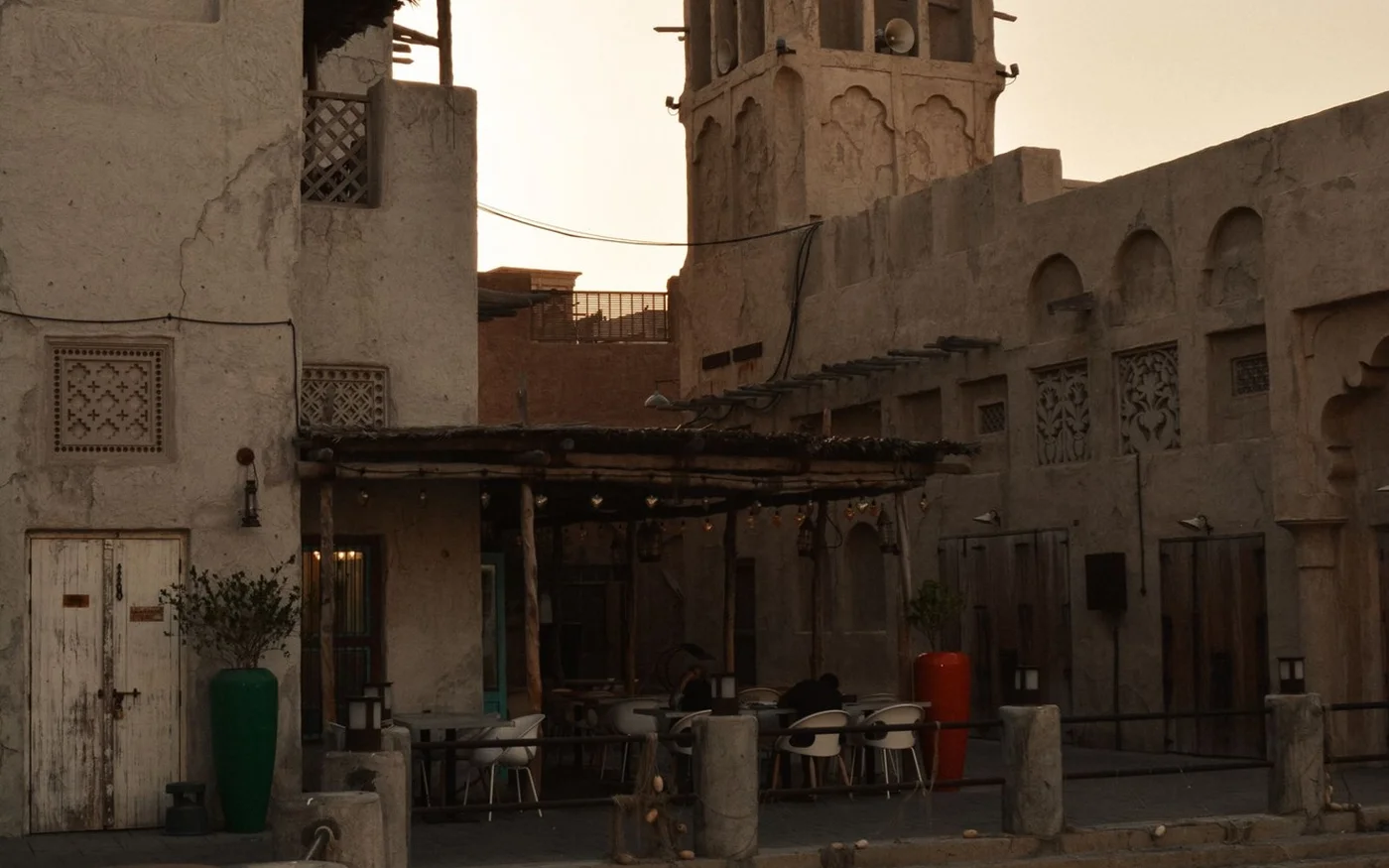
Al Fahidi Fort and Al Shindagha Museum tell related stories about Dubai Creek, but they are at different points in their public lives. The National Cultural Map describes the fort as undergoing rehabilitation, with a new museum experience planned. Al Shindagha has a documented opening after development and a current destination listing. Dubai’s wider architectural preservation programme extends the question beyond museums to buildings many people know from everyday life. Each record answers a different question about what has been restored, what a visitor can enter and what remains on the programme. Al Fahidi Fort status · Al Shindagha opening record · Heritage architecture programme.
Al Fahidi Fort is being prepared for a new museum experience
In February 2026, the Government of Dubai Media Office said Sheikha Latifa bint Mohammed had reviewed the final phase of the fort’s rehabilitation. The release described six galleries and exhibition spaces, with artefacts, archival photographs and documents alongside digital and audiovisual displays. It also gave the first half of 2026 as the planned opening period. That period has passed. The National Cultural Map still describes rehabilitation and a future opening. Readers planning a visit should look for a dated public admission announcement and current hours before treating the fort as open. February progress visit and gallery plans · National Cultural Map’s public listing.
The fort is itself part of what the museum will interpret. The National Cultural Map dates it to 1787 and describes walls built from coral and shell stone held together with lime. The building served as a defensive structure, a ruler’s residence and a centre of government before becoming Dubai’s first museum in 1971. Those roles give visitors a way to read the structure as an object in its own right. A gallery can display an archival photograph or explain a period of Dubai’s history, while the fort gives that story a physical setting. Official building and use history.
The February site visit shows that the museum design had reached the point where officials could see galleries and review the work. A visit of that kind has different implications from a public opening. It can establish progress inside a site without establishing when visitors will be admitted, which galleries will be available on day one or whether entry will require a reservation. The new gallery plans are useful for understanding the restoration. Admission details will need their own announcement. Government progress report.
The rehabilitation project began in 2021. The Government Media Office’s February 2024 account records approval of the vision and final design and describes Dubai Culture’s work on the architecture, exhibitions and museum content. That is an earlier milestone than the February 2026 gallery visit. Read together, the two records show the progression from agreeing what the museum would be to reviewing its spaces on site. They also show that rehabilitation here includes two kinds of work. The historic fabric must be preserved, while a new exhibition has to make the building and collection intelligible to a visitor. Those milestones still leave the date of public admission open. 2024 design approval · 2026 gallery and progress update.
Applus+, a project participant, described the investigative side of the work in February 2025. Its account says the team surveyed the fort’s condition, studied its history and developed restoration strategies. It also describes laser scanning, vibration monitoring and environmental logging. These methods answer different questions. A scan records the building’s geometry. Vibration sensors and environmental logs help the team observe conditions over time. Together, they give conservators more information about the structure before they decide where an intervention is needed. The account describes how the fort was assessed. It does not give a wall-by-wall record of what was replaced or retained. Project participant’s conservation account.
Those surveys help explain why the exhibition plans and the building work deserve separate attention. The fort’s coral and shell stone belongs to the history the museum will tell, while the planned displays give visitors other ways to understand the site. In a building that has served as a place of defence, government and public exhibition, the walls carry evidence of more than one period. The February 2026 plan says the galleries will follow that history through archives and objects. When the fort opens, the published gallery plan can be compared with the spaces actually offered to visitors. Fort fabric and historical uses · Planned museum interpretation.
In a January 2026 preview reel shared by Al Fahidi Fort and Dubai Culture, one illustrated scene places the fort among low buildings, palms and sailing boats by the Creek. The image conveys the setting the museum wants visitors to imagine. It is a promotional reconstruction of a historical scene. The caption recalls the building’s transition from fort to museum and asks readers to watch for opening details. That combination is useful for understanding the story Dubai Culture intends to tell. For someone deciding whether to go inside, the information to look for is a dated notice giving the terms of public admission. Fort and Dubai Culture preview reel.
The historic neighbourhood has its own programme
Al Fahidi Historical Neighbourhood and Al Fahidi Fort are often mentioned together, so a headline about one can sound like an update on the other. In January 2022, the Government of Dubai announced a strategy to rehabilitate and revitalise the neighbourhood. It covered cultural programming alongside work on facilities and the public setting. Dubai Culture’s June 2025 activation programme put part of that approach into practice through guided experiences and craft activities. The announced activities included a July session about wind towers and an August workshop on bookmarks inspired by the neighbourhood. Those dated activities show how Dubai Culture used the district while the fort followed its own rehabilitation timetable. 2022 neighbourhood strategy · Dubai Culture’s 2025 programme announcement.
Visit Dubai’s neighbourhood page describes traditional wind towers and places such as the Coins Museum. A visitor can use that page to understand what the district offers and then check individual doors and programmes. The date of a past workshop gives context for how the buildings are used. It cannot confirm that the same session is available now. Similarly, a neighbourhood listing shows that there are places to visit in Al Fahidi while leaving the fort’s opening date to a separate source. It helps to search for the full name of the building and the organisation that operates it when checking a particular visit. Visit Dubai’s neighbourhood listing · The fort’s separate listing.
Al Shindagha shows what a restored district can become
Al Shindagha Museum gives the comparison a completed milestone. The National Cultural Map records its 2023 opening after development. Dubai Culture later described 22 pavilions spread across more than 80 historical houses. This is a different museum form from the fort. Moving between houses and pavilions is part of how the visitor encounters the place, rather than a transfer between galleries inside one building. The museum’s visitor information can help a reader confirm what is available on a particular day. Al Shindagha opening record · Dubai Culture’s description of the museum · Visit Dubai’s museum listing.
The restoration story also has stages within the district. In 2020 Dubai Culture marked a reopening with a photography programme at the Perfume House and the Dubai Creek: Birth of a City House. The 2023 record describes the wider museum after development. The dates can coexist because they refer to different milestones. A reader looking for one particular house should use the current museum information for that house where available, even when the district’s overall opening is well documented. 2020 house reopening programme · 2023 museum milestone.
The museum’s published map gives examples of how the restored buildings are used. The Perfume House follows ingredients and perfume-making practices. The Culture of the Sea pavilion interprets pearling, while the Traditional Crafts exhibits include weaving and embroidery. These are different parts of the museum rather than rooms that tell the same story. If one is the main reason for a visit, check its availability directly. The map says most houses offer step-free access. For a particular building or a route between them, ask the museum which approach is available. Museum map and access guidance.
The official March 2023 inauguration took place at Sheikh Saeed Al Maktoum House. That location ties the redevelopment to a specific building within the district. The contemporary inauguration report described 22 pavilions and 80 historic houses, while Dubai Culture’s later account describes more than 80. Both give a sense of the scale. A visitor should still read the museum map by pavilion and house. A figure for the entire development says little about which interior is part of a particular ticket, tour or temporary closure. The museum can answer that question for a named house and date. 6 March 2023 inauguration · Later museum description · Official museum listing.
The district model also affects how the story unfolds. At the Perfume House the focus is on ingredients and making, while the Creek house places the waterway at the centre of the city’s development. Putting the subjects into separate houses lets the restored setting take part in the interpretation. For someone comparing this project with the planned fort experience, the difference is where the visitor moves. At Al Shindagha the historical streets and the spaces between houses belong to the setting. At the fort the published proposal brings the new galleries together around one monument and its history. Visit Dubai’s museum description · Fort museum plan.
The Deira Clock Tower shows another kind of preservation
Some of the buildings in Dubai’s preservation programme are part of the city’s daily infrastructure. The Deira Clock Tower is one example. Dubai Municipality dates the landmark to 1963 and ties it to the road connection between Deira and Bur Dubai. The Municipality began an overhaul of the roundabout in May 2023 and announced completion that August. The work included renewed surfaces, a redesigned fountain, lighting and landscaping. The clock tower remained the centre of the composition, with the work changing the setting around it. Municipality’s history and project summary · August 2023 completion notice.
The distinction matters when reading a restoration headline. The Clock Tower is a landmark within a functioning junction. The completion notice describes how its surroundings changed and does not describe a museum entrance or a pedestrian attraction at the centre of the roundabout. You can understand the outcome by comparing the retained landmark with the documented changes to the fountain, surfaces and planting. For this landmark, the public benefit comes from how it is seen in the street around it. Completed scope of the roundabout project.
The 2023 intervention followed earlier work on the tower itself. The UAE Ministry of Culture describes deterioration in the original concrete and a major rebuilding around the beginning of the 1970s. Visit Dubai dates a renovation to 1972. Those records use different dates, so the earlier work is best understood as part of the landmark’s history without assigning a precise year to a single event. The 2023 completion release provides a clearer account of the later project. It describes the tower’s setting, including a new fountain and lighting, and explains which features were introduced around the structure. Ministry of Culture heritage record · Visit Dubai’s Clock Tower history · 2023 project completion.
The clock tower also appears on the list of 35 sites and buildings covered by the second phase of Dubai’s heritage architecture preservation project, approved in May 2024. The list includes Al Ras Library, Dubai Municipality’s main building and Terminal 1 at Dubai International Airport. It shows how recent architecture can become part of the city’s heritage record alongside older forts and houses. Each site needs a separate update before readers can say work has started, a restoration is complete or any visitor arrangements have changed. Phase 2 list and approval · Municipality’s modern heritage directory.
Dubai’s historical district project offers a broader view of what the separate interventions have in common. Visit Dubai describes work across Al Shindagha and Al Fahidi, with Saruq Al Hadid among the museum sites involved. That district-level view helps explain why a fort, a collection of houses and a programme of activities may all appear in an account of the same part of Dubai. The project’s boundaries are wider than any one venue’s admission arrangements. The useful question is which announcement applies to the place you are interested in, and what that announcement actually says people can do there. Dubai Historical District overview.
The preserved form can carry meaning even when some of the material or machinery has changed. At the junction, the clock marks a place people recognise as they move through Deira. In the fort, the building’s fabric and earlier uses are themselves part of the museum story. At Al Shindagha, the houses provide a setting for interpreting activities such as craft and trade. These different purposes help explain why there is no single test for when heritage work is complete. A completed street project can be visible from public space. A restored museum needs staff, exhibits and an admission route before a visitor can experience the interior. Clock Tower landmark description · Al Shindagha’s museum interpretation.
What would confirm the next reopening
Use the date and scope of an announcement to decide what has changed. For a project on a preservation list, look for a later notice describing work on that particular building. For a site in its final rehabilitation phase, look for a statement that the venue is admitting the public and check what the opening covers. At Al Fahidi Fort, useful details would include the first admission date, published hours and any booking or access arrangements for the new galleries. For Al Shindagha, the question is narrower because the museum already has a visitor listing. Check whether the particular house you want to see is part of the visit on the date you choose. Fort project listing · Al Shindagha museum listing.
For any planned opening, keep the evidence of completed work and the evidence of access together. A museum may publish an opening announcement before every programme has its own timetable. A destination guide may identify a house without explaining whether it has a separate ticket. If the aim is to see a particular interior or exhibition, use the exact name when contacting the venue. That keeps the question tied to the restored space you want to see, even when several places share a district name. Al Shindagha visitor information.



Comments (0)
No comments yet. Be the first!